In this module, you will be asked to consider that SETBACKS are a natural consequence of any weight management effort — and that success is determined not by whether or not you experience setbacks, but by how you respond to them. This is the principle of resilience.
The process
The process of resilience skill development is straightforward:
- Recognizing the thoughts and emotions that automatically arrive in the aftermath of a setback — thoughts that speak poorly about you and your ability to manage your weight.
- Learning to challenge these thoughts. This is the process that generates resilience. You will discover how changing your thinking helps you recover from setbacks and maintain motivation to adhere to your weight management efforts.
You may remember from earlier that adherence — the degree to which you are able to maintain the changes you have made — is most strongly associated with weight loss and improved health. Resilience is a key skill in determining adherence. Like wanting and restraint, the capacity to practice resilience is a variable trait1 and is highly heritable.
Setbacks can negatively affect adherence. Three are particularly common. As you read them, try to picture yourself in the immediate aftermath of each one, and imagine how you feel.
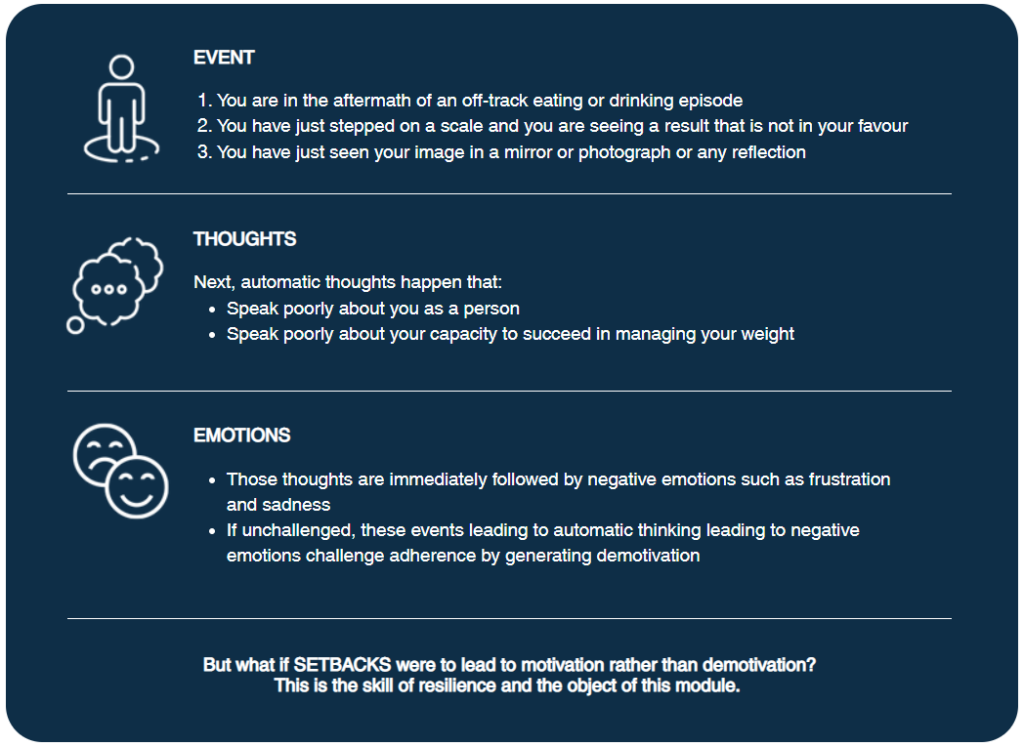
In the restraint module, you were invited to discover, challenge, and ultimately change autopilot thoughts — also called permission thoughts. In this module you will see an exact parallel. You will be invited to discover, challenge, and ultimately change another set of automatic thoughts.
Remember that we have two thinking systems: one that is fast and automatic, and a second that is slow, deliberate, and forward-thinking. Here, the fast-thinking autopilot generates thoughts that come when you are in the aftermath of a setback. Where do these thoughts come from? Why are they there?
These thoughts are the product of your past weight loss efforts. (If you have not tried to lose weight in the past, these may not be present, and may not be an obstacle.) If past weight loss efforts have been challenging or numerous, it is quite likely that you have developed a library of automatic thoughts that:
- Speak poorly about you as a person.
- Speak poorly about your capacity to succeed in managing your weight.
These negative thoughts use your past weight loss efforts and failures as evidence against you. Their predominance will also be a consequence of genetics, the presence of depression or anxiety, and even of childhood experiences. In what follows, you will learn the proven method of developing and strengthening resilience.
The three-step process for resilience
Resilience is built using cognitive-behavioural therapy. The actual tool of CBT here is cognitive restructuring — literally, changing one's thinking.
- The first step is discovering your automatic post-setback thinking.
- The second step is challenging those thoughts with evidence.
- The third step is creating new resilience thoughts based on your evidence.
With practice, these new resilience thoughts may become the new response to setbacks, displacing negative thinking.
Setback 1 · Off-track eating or drinking
Step 1 · Discovering self-critical thoughts
Capturing self-critical thoughts sounds easy enough — but in fact, learned self-critical thoughts are automatic and fleeting, and often go unnoticed. They have three unique characteristics:
- They immediately follow setbacks.
- They are automatic, not controllable.
- They will speak poorly about you as a person, and your ability to sustainably lose weight.
Identifying self-critical thinking looks like a funnel. At the top are a number of thoughts that become fewer as you go deeper, ending in as little as one root thought at the bottom.
This last thought at the bottom of the funnel is a root thought. In the aftermath of setbacks, this is an exceedingly common one.
Step 2 · Where is the evidence?
Fortunately, this second step is not necessarily easy — but it is straightforward. Ultimately, you may realize that the evidence supporting your thinking and your root thought is based on your past weight loss experiences and failures. So, for a moment, think about your past weight loss efforts.
In the past, when you were provided an ethical, comprehensive, and effective behavioural weight management program over a long period of time by trained health care professionals — potentially combined with effective and safe medication — how did it go?
It is very likely that your answer is: "I have never experienced that before." But the question above is the actual treatment for the real medical condition you live with.
If you have never been comprehensively and effectively treated for the real condition you live with, this brings up an important question. Is it possible that your past weight loss efforts are inadmissible evidence as to whether you can effectively and sustainably lose weight? Can you challenge the root thought above based on the fact that you have never been effectively treated in the past?
Step 3 · Creating new resilience thoughts
This last step sets you up for thinking differently in moments of setback. In place of self-critical thoughts, could setbacks be followed by thoughts such as these?
"I can view this as a reminder that this is difficult, and that setbacks are inevitable. I know that how I do long term will not be determined by my setbacks but by how I respond to them. I know the automatic thought in this moment revolves around me not being able to succeed — but I also know that thought is based on my past. I have never been supported with comprehensive behavioural treatment. I have never in the past been properly supported by safe and effective medication."
As confidence builds, you may encounter thoughts in these moments that sound like:
"I know what I am capable of. I know when I do it, it works. I know what to do, and I know how to do it. I know the pathway that works for me, and is still very enjoyable, at a level of effort that is sustainable. Let me roll up my sleeves and try to understand why this setback happened. Let me get support."
From demotivation to motivation
There is a truism in psychology that thoughts lead to emotions, which lead to behaviour. If unchallenged, the original self-critical automatic thoughts generate emotions such as frustration, disappointment, anger, sadness, and feelings of failure. These emotions ultimately lead to demotivation — and a single setback can set you up for more setbacks. An unfortunate demotivational cycle can begin.
By identifying, challenging, and replacing the automatic thinking, setbacks may instead become a source of motivation — a golden opportunity for learning, progress, and ultimately success.
There are many aspects of weight management that you do not have control over: genetics, your upbringing and conditioning around food, the food environment that surrounds you, and how strongly your brain defends against weight loss. Resilience development is a skill you can roll up your sleeves for and work on. You may not be able to control whether or not setbacks happen on your path to your best weight — but to a significant degree, you can control how you respond to them. The skill of resilience can be developed progressively, and the consequence is adherence — the key predictor of long-term success.
Setback 2 · The scale
The number on the scale can generate negative thinking, negative emotions, and demotivation. Here are some common scale-related scenarios that can trigger that cascade:
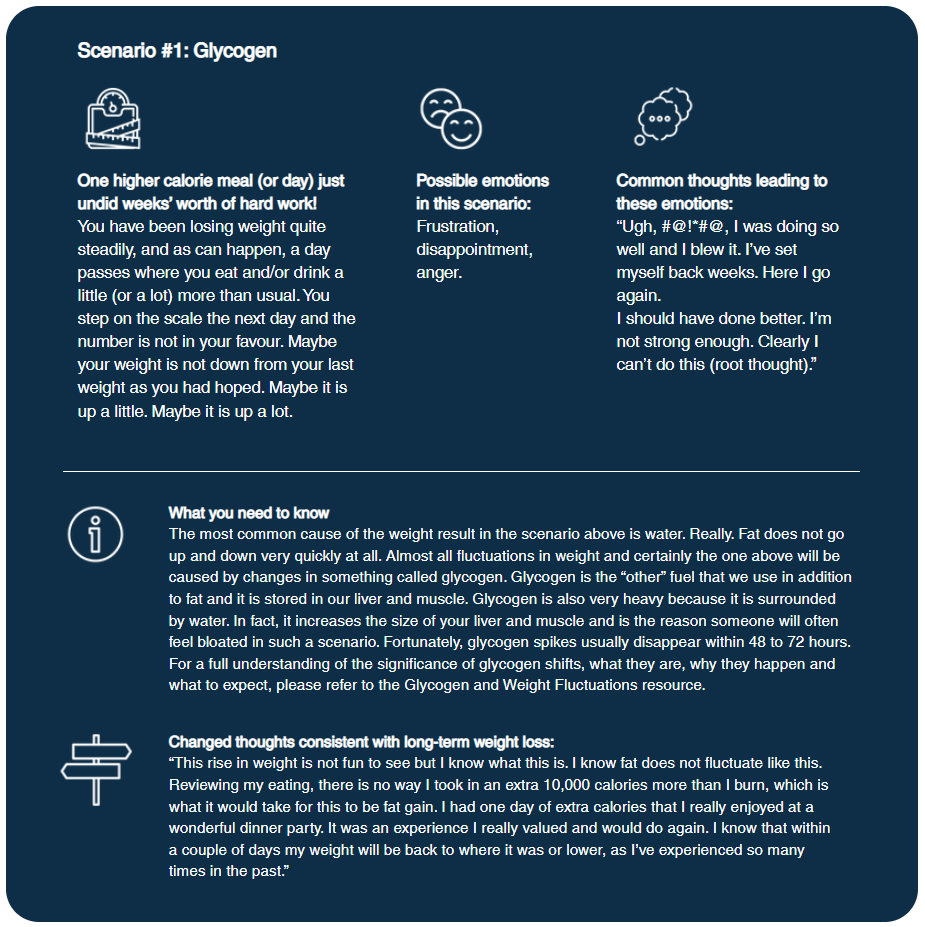
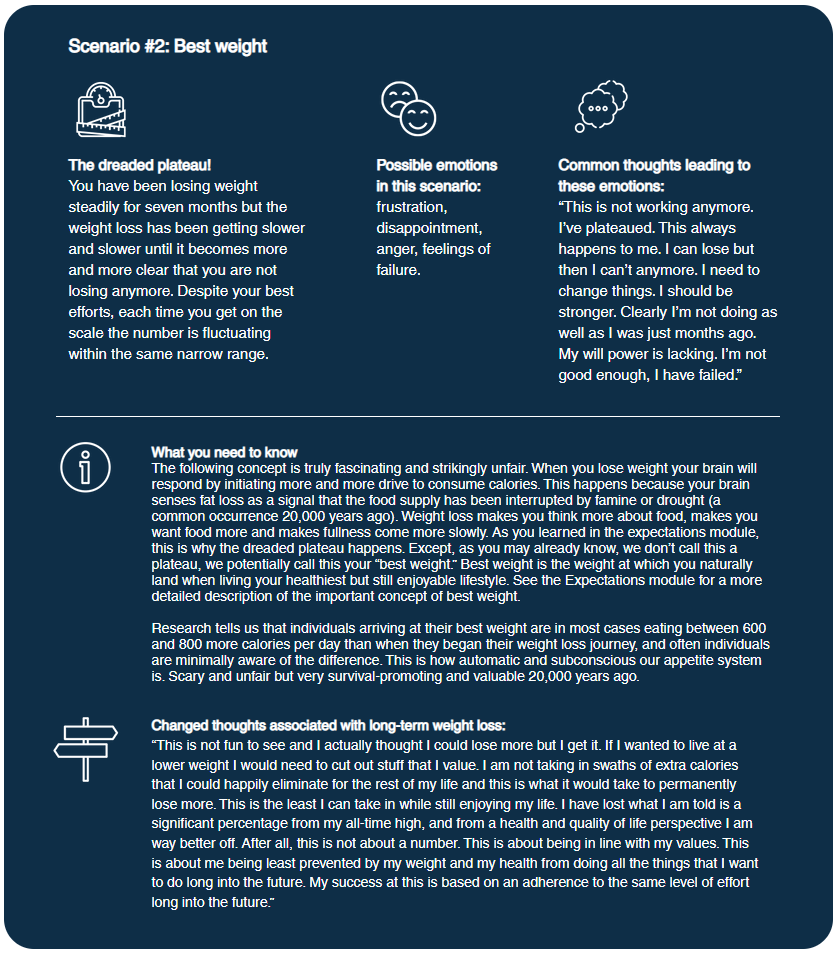
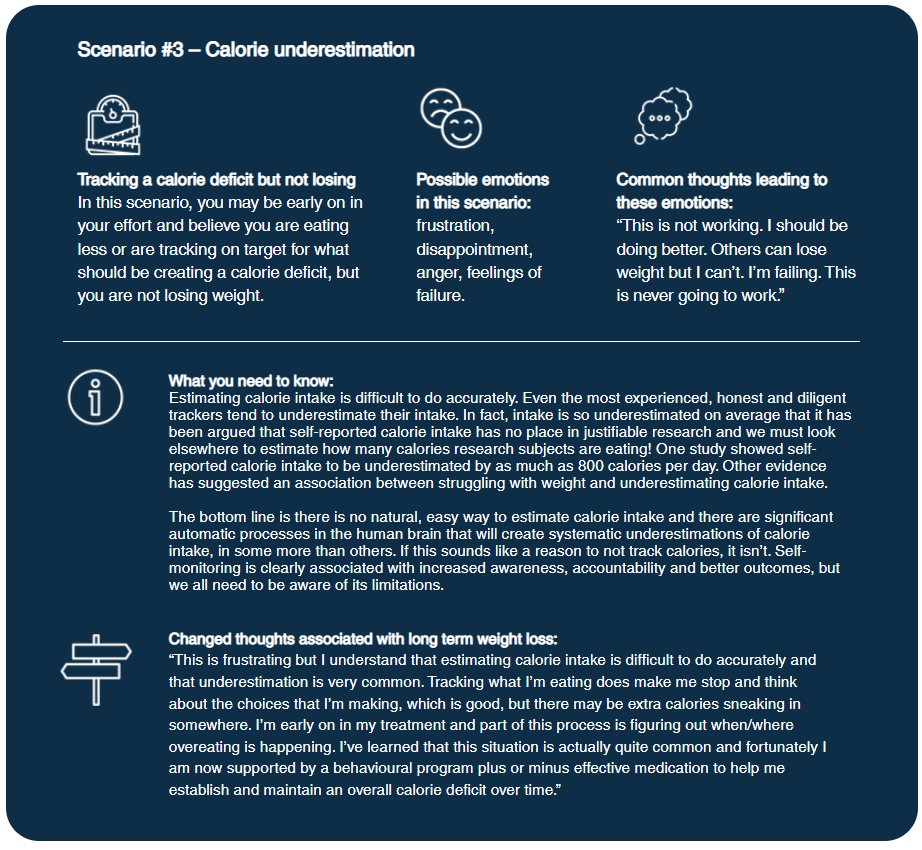
The same three-step process applies. Discover the automatic post-setback thinking that the scale triggers. Challenge it with evidence — where is the evidence? And rewrite a resilience thought to take its place. The skill is identical; only the trigger is different.
Setback 3 · Body image
You have now learned that the aftermath of an off-track eating or drinking day, and the aftermath of seeing a number on the scale that is not in your favour, can each initiate automatic processes that lead to negative thinking, negative emotions, and demotivation. A third event that can ultimately result in demotivation is exposure to your own image:
- Seeing yourself in a mirror or reflection.
- Seeing yourself in a photograph.
A note on body dissatisfaction
The most common reasons given for wanting to lose weight are related to appearance — satisfaction with looks and attractiveness. You may be surprised to learn that weight loss is generally an ineffective way to accomplish increased satisfaction with how you look. It is extremely common that someone will lose weight and still feel dissatisfaction with their appearance. Body dissatisfaction, if present, is something you can work on improving in parallel with — or independent of — your body weight.
Body satisfaction, like so many other weight-related factors, is about your thinking. Those who feel better about how they look change the way they think about their bodies. By changing the way you think about your body, you can improve how you feel about yourself.
You may be surprised to know that there is only a weak relationship between body satisfaction and actual appearance. What you look like does not always correlate with how you feel about your appearance. This is particularly true when it comes to body weight. Many non-overweight people dislike their appearance, and many heavy people are content with their appearance and feel attractive.
Body satisfaction comes down to your thinking. Your dissatisfaction with your body is much less about your body, and much more about the thoughts and beliefs you hold about how you look. Throughout your life you have developed thoughts about your appearance that have been created in response to your day-to-day interactions with people, and within our culture. Our society is very concerned with physical appearance, and overweight is regularly stigmatized.
Have you ever experienced personal or professional rejection, criticism, or teasing based on how you look? What is the earliest life experience you can recall in which attention was brought to your appearance, shape, or size? Were there times in your childhood, your teenage years, or later in life when people around you criticized your appearance?
The path to body satisfaction involves working on accepting your body, even though you recognize that your appearance may be less than perfect.
Step 1 · Discovering self-critical thoughts
Are you ready for the hard work of capturing the thoughts that have come to be associated with your appearance? Are you ready to improve how you feel about yourself?
Remember that automatic thoughts lead to emotions. Your work starts by asking yourself two questions:
- If you look at yourself in a mirror — or imagine yourself in a mirror — what thoughts and emotions can you identify?
- If you see yourself in a photograph or reflection, what thoughts and emotions can you identify?
In these moments, you might feel emotions such as shame, embarrassment, disgust, or a feeling of failure or hopelessness. These emotions are a product of your thinking. You may use the recognition of negative emotions as a cue that negative thinking patterns are happening.
The funnel pattern applies here too:
Step 2 · Where is the evidence?
In the case of battling body dissatisfaction, you have a significant advantage. Intellectually, everyone can imagine that the character of a person — their kindness, their values, their generosity — has nothing to do with the shape of their body. You have learned elsewhere that 70% of the shape and size of someone's body is influenced by genetics and governed by a unique three-layer ancient appetite system. You have learned that, although effective treatment exists to support finding one's best weight, you have likely never received such treatment before.
You also learned to believe your internalized self-critical thoughts early in life, because of the societal stigma directed at overweight individuals. Can you challenge these previous thoughts? What if your thoughts about you and your body are different from what others think about you? Imagine if we brought all your close friends together in one room and asked them about you. What if we asked them whether you are disgusting, weak, undisciplined, and a failure? It is very likely that your friends would argue vehemently against this characterization.
Ultimately, you can realize that any evidence you hold supporting your current thinking is based on stigmatizing and biased internalized messaging from your past. Furthermore, you have never been comprehensively supported for the real condition you struggle with — yet effective treatments exist.
Step 3 · Creating new resilience thoughts
This last step sees you thinking differently when exposed to your image. In place of the self-critical thoughts above, could seeing your image be followed by thoughts such as these?
"I am on a journey to find my best weight. My struggle is real, and I have never been treated before — not once. Who I am as a person is not a product of my shape and size. I do not have to love the way I look — but I can certainly challenge the notion that how I look speaks to who I am as a person. I will work in the direction of finding my best weight, and I will consider accepting — maybe begrudgingly at first — that my best weight is the best I can do."

Three questions for resilience.
Setbacks are inevitable. The next time one happens — an off-track day, a number on the scale, an image of yourself — pause before the automatic thinking takes over, and ask these three questions.
-
What am I thinking right now?Catch the thought before the emotion catches you. Try to write it down or say it aloud. The fast-thinking autopilot is loudest when it is unobserved; naming the thought is the first step in slowing it.
-
Where is the evidence?Is this thought based on genuine evidence — or on past weight loss efforts that were never supported by comprehensive treatment? Would your closest friends agree with this characterization of you?
-
What is the resilience response?Setbacks are not failures. They are opportunities for learning. What is the slower, more deliberate, more accurate thought that this moment deserves?
- Amstadter AB, Myers JM, Kendler KS. Psychiatric resilience: longitudinal twin study. Acta Psychiatrica Scandinavica. 2014. View source ↩