Did you know permission thoughts exist for a reason? For our ancestors, when a calorie opportunity was subconsciously recognized — that is, when wanting was triggered — thoughts immediately followed about how and why they should go and get. These thoughts did nothing less than ensure survival in a calorie-unreliable world. It makes sense that they would be persuasive. It also makes sense that they would be automatic. They are learned from past successful food-finding missions.
Restraint skill development
This section describes how to develop, as best you can, the capacity to restrain against wanting. Restraint means changing your thinking, and then your behaviour, in moments of wanting. It is about the processes of human decision making.
When wanting is reflexively triggered, it gets shuttled up to the executive system — the front of the brain, the conscious part where decisions get made. To understand this part of the brain, think of it as composed of two parts.
The first is called the autopilot, or system one — a fast and automatic system of thinking that focuses on immediate gratification. The second is the potential hero of this story: system two — a slow, deliberate system of thinking that, when considering choices, can weigh consequences and consider the future. This is where deliberate self-regulation happens. To further understand it, there is one more key point: this part that thinks slowly and about the future must be deliberately engaged, and most often is not. Most decisions get made by the autopilot, the fast-thinking system — especially decisions around food. These automatic thoughts are also called cognitive bias.
This section discusses the skill of engaging system two — your deliberate self-regulation — to your advantage in moments of wanting. These are the key decision moments regarding eating, drinking, and activity that determine1 one's best weight. This skill of restraint goes by many names in the literature, depending on whether you are reading neuroscience or psychology — we will use the term cognitive restraint, described by Rena Wing2, the grandmother of behavioural weight management, as the central behavioural attribute of those who sustainably lose weight.

When it comes to restraint skills, not everyone is on an even playing field. Cognitive-executive restraint is considered a variable trait3 and is highly heritable. Fortunately, effective behavioural strategies4 exist to improve restraint skills. Restraint development involves changing thinking. Cognitive-behavioural therapy and acceptance-based therapy play large parts in this work. The skill of cognitive restraint can be learned and improved over time and with repetition — much like a muscle builds in strength when working against resistance. MRI studies have shown changes in this part of the brain in as early as 12 weeks in those who successfully practice restraint.
In this module you will be invited to discover, challenge, and ultimately change autopilot thoughts — also called PERMISSION THOUGHTS. Permission thoughts speak in moments of wanting about why one should eat or eat more. They sound like justifications or rationalizations. New thinking in moments of wanting can be learned and practiced, and this new "restraint thinking" is the foundation of sustained behavioural change. In best-weight terms, this is the skill that generates adherence to a long-term, overall lower calorie intake.
We now live in an environment where calories are limitless, yet permission thoughts are a built-in part of food decisions that drive us in the opposite direction of our best weight. Permission thinking is another example of a system that conferred advantage in a former environment, and now confers disadvantage in this one.
A phrase worth carrying: cravings don't travel alone. Wanting arrives, and permission thoughts arrive with it — almost as the wanting's spokesperson, justifying. I've had a hard day. I deserve this. Just this once. The two come together. If you can notice the craving, you can notice the thought; if you can notice the thought, you can work on it.
So wanting and permission thinking are both automatic. We don't control them. They come from underneath as we navigate this food-filled environment.
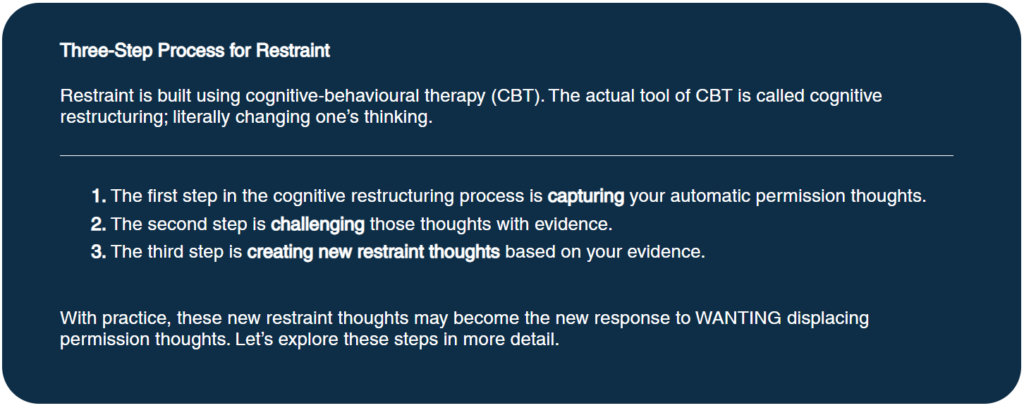
Step 1 · Capturing permission thoughts
Capturing permission thoughts sounds easy enough, but in fact they are automatic and fleeting, and often go unnoticed. Permission thoughts have three unique characteristics:
- They immediately follow wanting.
- They are automatic, not controllable.
- They may sound persuasive and convincing in the moment, but by nature they are irrational and untrue — in fact, often the direct opposite of the truth.


The following are common categories of permission thoughts. They are so common and universal that we can name them:
- Credit card — I can have this now, and later I'll eat less.
- Deserved or earned — I've had such a hard day, I deserve this.
- Gateway — I'll just go and see what there is. I'll just have a small amount of this.
- Resignation — I'm not losing weight anyway, so I may as well.
- On track — I've been doing so well lately, I deserve this.
- Off track — I've been doing so poorly lately, I may as well.
- Social and cultural norms — It would be rude in this circumstance not to eat this.
- The rebel — No one can tell me what I can and can't do. I can do what I want.
- Balancing calories — I have room for this in my calorie target.
- The straw man — I'm not eating donuts and ice cream, so this is fine.
- Utilitarian — This will help me feel less stressed, tired, upset, or sad.
- Novel — I haven't had this for a long time.
- Hedonist — This is great. I just love this.
Step 2 · Challenge and rewrite
Once you have captured your permission thoughts, ask: Where's the evidence? What evidence supports the thinking, and what evidence does not?
Imagine you are in court.
Imagine you have been accused of a crime and you're standing in court. The prosecution lawyer stands up and gives the jury three convincing arguments as to why you should be convicted. The jurors nod their heads. You're worried. The prosecution rests. If the case ended here, you would most likely be convicted. But what about the defense? Imagine next that a highly skilled defense lawyer stands up and expertly refutes and discredits the prosecution's three arguments. Case closed; you go free. To challenge permission thoughts, you need to bring forward evidence that refutes and discredits the permission thinking — and sways your jury back in your favour.
The evidence is called restraint thinking. For our purposes it is also called values-based thinking: Do I value this? Is this important to me? How will I feel afterwards?
This is where your values become operational. The values you clarify in Module 07 — your health values and the values that make life worth living — are not held in the abstract. They are the content system two reaches for when it answers a permission thought. Is this aligned with what I value? Values live inside the moment of restraint. That is where they do their work.
Below are 13 categories of permission thoughts you may recognize, each paired with a restraint response. Once you have captured and challenged a permission thought, new restraint thinking essentially writes itself.
I have said this before and not eaten less later. Anyway, this is about this moment, and building the skill in this moment.
If it comes down to what I deserve, I deserve to feel in the direction of what's important to me. This is not important to me — and in fact this would leave me feeling regretful and unhappy. I don't deserve that.
If I go and see, I will be more likely to have something. And if I have something, I will be likely to have more.
Struggling with weight is a real condition. I have support, I have access to treatment, this is a long-term project — and every moment of restraint counts.
If this is important to me, I can have it — but not for this reason. Rewarding "doing well" with a setback does not make sense.
Struggling with weight is a real condition. I have support, I have access to treatment, this is a long-term project — and every moment of restraint counts.
I value food and fun, drinks, socialization, and celebration. Is this one of those moments? If not, I should advocate for myself and continue in the direction of what is important to me.
I should do what I want — but do I want this? Is this important to me? Because if it isn't, I may feel regretful and unhappy afterwards, and that I don't want.
My key skill is restraint in the moment of wanting; effort against resistance builds my restraint skills like exercise builds muscle. Landing at the right calorie level on a given day is a secondary consideration. If I am hungry, or if I really value this, then fine. Otherwise, just because I have room does not mean I should eat it.
My effort should be in the direction of restraint skill development. So if this is not for hunger, and is not important to me, I can pass.
After eating this, will I really feel less stressed, tired, upset, or sad? I know I will feel relief from wanting — but only for a moment, and nothing else will change. In fact, I may feel more stressed, tired, upset, or sad after eating it.
If this is important to me, I should have it. But the length of time since I last had it will not play into my decision.
Is this important to me now, and how will I feel afterwards? My efforts should be in the direction of restraint skill development and finding my best weight.
You may notice a pattern. Permission thoughts focus on the immediate, and discount the future. Restraint thoughts do the opposite.
The three root questions of restraint thinking.
When wanting arrives, and a permission thought follows, ask yourself these three questions. They are at the root of all restraint thinking.
-
Is this aligned with my values?Do I value this — really? Or am I being driven by something automatic that doesn't reflect what matters to me?
-
How will I feel afterwards?Not five seconds afterwards — five minutes, an hour, tomorrow morning. Will I feel relief that I had it, or regret?
-
Is this building my restraint skills, or impairing them?Restraint is a skill. Like any skill, it is built by repetition. Each moment of restraint strengthens it. Each moment of giving in weakens it.
More restraint thoughts.
The three root questions are the spine, but restraint thinking in a slow, deliberate moment can be a varied collection — and the best examples are often the ones you generate yourself. They are additive; they are all great. New system-two thinking might sound like: Do I need this? Am I hungry? How will I feel afterwards? Will I feel better if I don't? Is this really aligned with my values? Is this wanting — and isn't wanting something I could be working on, noticing it, ultimately changing my behaviour or managing this high-risk time? And it can resolve into an action as much as an answer: For all these reasons, I'll not turn to food — or I'll move to a different setting, try something different, or wait at least fifteen minutes and see. Each is slow, deliberate, conscious thinking, and each is the end point of successful behaviour change — cognitive restructuring in practice.
Amazingly, if done properly, displacing permission thoughts can directly reduce wanting itself. Like turning down a dimmer switch, restraint thoughts may dim or turn down the volume of the impulse — literally making wanting feel less strong.
- Vainik U et al. Executive function in weight loss and weight loss maintenance: a conceptual review and novel neuropsychological model of weight control. 2017. View source ↩
- Wing RR, Phelan S. Long-term weight loss maintenance. American Journal of Clinical Nutrition (NIH). View source ↩
- Lowe CJ et al. The Prefrontal Cortex and Obesity: A Health Neuroscience Perspective. Trends in Cognitive Sciences. 2019. View source ↩
- Forman EM et al. Acceptance-Based Versus Standard Behavioral Treatment for Obesity: Results from the Mind Your Health Randomized Controlled Trial. Obesity. 2016. View source ↩