Working to find your best weight is tough enough in itself. Unfortunately, certain internal states can make this process even more difficult. In this module you will be introduced to a finite list of modulators that can be obstacles between you and your best weight.
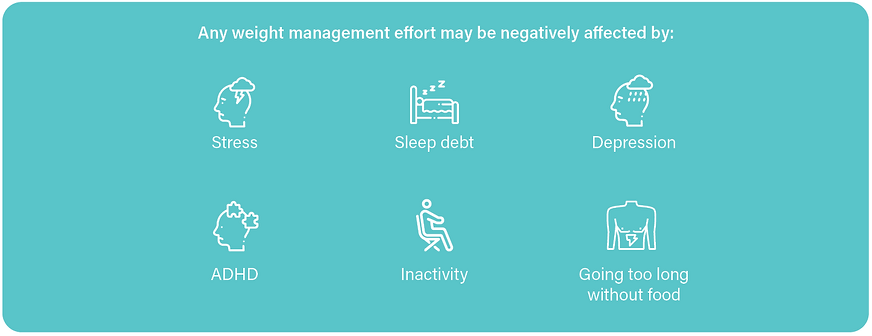
Not everyone living with overweight or obesity is negatively affected by every modulator — and you should be supported in a personalized discovery and review of each one, and how it applies to you.
How modulators work
Managing these barriers starts with understanding how they work — and fortunately, this is not complicated. You are reminded that overeating is driven by both the homeostatic system (in the hypothalamus) and the motivation system (the brain's reward circuitry). The only thing standing up to it all is the executive system.
The risk of every modulator is that it does one of three things:
- Increases activity of the homeostatic system — making the hypothalamus more aggressive in defending against weight loss.
- Increases the learning and strength of the motivation system — making it more reactive to food cues, with stronger and more persistent wanting.
- Increases the difficulty of engaging the executive system — leaving the autopilot with free reign over decisions, including decisions about food.
All effective weight management strategies should regularly consider and revisit this list of modulators as possible obstacles and targets of intervention.
The six modulators
01Stress
Stress is the body's response to challenge or demand. In short bursts, it can be positive, helping us overcome an acute threat. If prolonged, however, stress can affect quality of life, health, and weight. Our stress system evolved to help us escape life-threatening situations — dumping glucose into the bloodstream so that muscles have energy for fight or flight. But in the modern world, most stress is psychological, while the body responds as if the challenge were physical.
Epidemiological studies show an association between stress and weight, and meta-analysis shows a relationship between stress and weight gain. Stress results in the release of the cortisol hormone from the adrenal glands and promotes fat gain within the abdominal cavity — the unhealthy version of fat, located at the centre of the body.
Stress and the motivation system. Stress directly increases the neurotransmitter dopamine, which raises wanting. Indirectly, stress also releases cortisol, which makes the motivation system more sensitive to cues that activate it, and strengthens wanting further. The hormones leptin and ghrelin1 also react to stress — leptin suppresses appetite while ghrelin stimulates it. Under stressful circumstances, high-calorie, hyper-palatable foods are preferred, which can further chronically sensitize the motivation system and progressively strengthen wanting.
Stress and the executive system. Stress can significantly undermine restraint over wanting. Early life stress can be particularly damaging to executive self-regulation skills. Stress directly decreases executive functioning, making the executive system unmistakably harder to engage.
Stress and weight bias. People living with overweight or obesity may frequently experience weight bias, stigma, and discrimination. The stress of weight bias has been demonstrated to create a vicious cycle, where stress leads to weight gain, which leads to more stress.
02Short sleep duration & fatigue
Decades of evidence describe an association between sleep and eating. As Jean-Philippe Chaput2 has summarized, the majority of the evidence suggests that short sleep duration is a causal force in weight gain and an obstacle to weight loss. Less sleep is now considered a part of modern living — and there is growing consensus that it is associated not only with weight, but also with type 2 diabetes, heart disease, hypertension, and mortality.

Short sleep and the homeostatic system. The homeostatic system defends against weight loss by responding to lower leptin levels. A landmark study by Karine Spiegel3 showed that two days of shorter-than-recommended sleep induced an 18% drop in leptin, while increasing the hunger and wanting hormone ghrelin by 28%. These hormone changes were also associated with increased reports of hunger and appetite.
Short sleep and the motivation system. Functional MRI studies show that short sleep duration enhances the activity of the motivation system — increasing both its activation and its sensitivity to images of calorie-dense and tasty foods. This effect goes away with normal sleep. Taken together, short sleep can result in more persistent and taller waves of wanting sent up to the executive system.
Short sleep and the executive system. fMRI studies confirm that sleep deprivation reduces activity in areas associated with restraint and inhibition. Sleep-restricted adolescents eat more high-energy foods, and sleep-restricted adults show less activity in the brain's inhibition circuits while food intake increases. Short sleep makes the executive system, already difficult to engage, harder still.
Short sleep duration is also suggested to increase dangerous intra-abdominal fat, and is associated with hyperactivity of the stress circuit (the HPA-axis), driving further cortisol release.
03Depression & anxiety
The relationship between depression and weight can be thought of as bi-directional — having one increases the risk of the other. A systematic review and meta-analysis4 of over 58,000 people found that obesity increases the risk of depression, and depression is predictive of developing obesity.
You may be surprised to learn that with depression, not everyone is at risk of weight gain. Some people with depression experience increased appetite and weight, while others experience the opposite — decreased appetite and weight loss. According to fMRI evidence, the motivation system is responsible for these differences. Depression-related increases in appetite are associated with overactivity of the motivation system, the mesolimbic reward circuit.
Consistent with the bidirectional pattern, animal studies have shown that chronic consumption of high-fat food and the associated weight gain induce changes in the reward circuit that are themselves associated with depression. Depression also plays a mediating role between executive self-regulation skills and obesity, suggesting it makes the executive system harder to engage in those with both depression and weight gain.
04ADHD
Various categories of studies have demonstrated an association between ADHD and symptoms of overweight and obesity. Research5 has identified significant overlap in the neurological circuits that mediate ADHD and obesity — specifically within the motivation system and the executive system, which mediates response inhibition and regulation.
Practically, this means that for someone living with ADHD, both wanting can be louder and restraint can be harder. ADHD assessment and treatment can therefore be a meaningful part of weight management for those affected.
05Physical activity & sedentariness
The relationship between physical activity and weight regulation is not straightforward — but the relationship between activity and the appetite system is. (The Diet, Exercise & Calories module covers the calorie-balance side of activity in more depth.)
Research has shown that moderate-to-vigorous physical activity is associated with decreased brain response to high-calorie food cues in the region of the motivation system, suggesting that physical activity can decrease wanting. Sedentary behaviour, conversely, was correlated with greater reactivity and stronger wanting.
Meta-analyses have also found that moderate- and high-intensity exercise has a positive impact on executive function — and restraint is a key executive function. Movement supports both the motivation system (quieting it) and the executive system (engaging it).
06Going too long without food
From an evolutionary perspective, the motivation system has two roles: producing the drive to go and get food when food may be scarce, and promoting overeating when food is available, in order to establish energy stores for an uncertain future.
When we go too long without food, the motivation system gets temporarily strengthened. Wanting gets stronger. A major supporter of this temporary strengthening is the food-intake-promoting hormone ghrelin. Ghrelin is produced in the stomach and is at its highest levels before we eat. It directly signals both the homeostatic system and the motivation system to promote going-and-getting, and then eating.
The most likely causes of increased ghrelin release include:
- Going too long without food.
- Anticipation of food.
- Weight loss.
- Psychological stress.
In the case of going too long without food, the signals that result in ghrelin release include low blood glucose and the release of norepinephrine. Simply anticipating tasty, hyper-palatable food may also result in ghrelin release.
Advocate for yourself
Working towards your best weight is tough enough. Modulators can make it more difficult. Please advocate for yourself.
It is recommended that your health care practitioners actively assess you for the effects of this finite list of modulators, and diagnose and treat them if necessary. If modulators are determined to be affecting your weight, treatments to consider include:
- Stress reduction and management strategies.
- Sleep testing for sleep apnea.
- Treatment for insomnia.
- Treatment for depression and anxiety.
- Assessment and treatment for ADHD.
- Strategies to increase physical activity.
- Avoiding going too long without food.
The list of modulators is finite. Each one can be assessed. Each one can be addressed. Working with them is part of comprehensive obesity care.

- Yau YHC, Potenza MN. Stress and Eating Behaviors. Minerva Endocrinologica. 2013. View source ↩
- Chaput JP. Sleep patterns, diet quality and energy balance. Physiology & Behavior. 2014. View source ↩
- Spiegel K et al. Brief communication: Sleep curtailment in healthy young men is associated with decreased leptin levels, elevated ghrelin levels, and increased hunger and appetite. Annals of Internal Medicine. 2004. View source ↩
- Luppino FS et al. Overweight, obesity, and depression: a systematic review and meta-analysis of longitudinal studies. Archives of General Psychiatry. 2010. View source ↩
- Seymour KE et al. Overlapping neurobiology of learned helplessness and conditioned defeat: implications for PTSD and mood disorders. Behavioral Neuroscience. 2015. View source ↩