Calorie deficit
At its most basic level, weight gain occurs when calorie intake exceeds calories expended. Conversely, weight loss only occurs when energy intake is less than total calories burned. Weight loss occurs when calorie intake is reduced — regardless of the percentages of fat, protein, or carbohydrates eaten. Calorie intake, not carbohydrate intake, is the determinant of body fat gain or loss.
At this point, the calorie content of food is literally the only food property that has ever been convincingly demonstrated to impact how much fat is carried in our bodies. This was most recently validated by a meta-analysis1 of 20 studies suggesting that, for all practical purposes, a calorie is a calorie as it relates to body-fat-weight.
Studies2 consistently show that, once heavier, heavier individuals consume and expend approximately 20–30% more calories than lighter individuals. Studies held within tightly controlled laboratories and dormitories demonstrate that reducing calorie intake by this same number invariably causes fat losses, suggesting that higher calorie intake is required to maintain higher weights.
Weight loss happens only if calorie intake is lower than the total number of calories we burn — but the math should not be mistaken as simply "calories in, calories out." The math changes in predictable ways when the brain detects fat loss (the homeostatic system) and generates increased appetite and decreased metabolic rate to favour weight regain.
Diet
What is the best diet for weight loss? What if the answer were a resounding none?
You will be asked to consider disregarding the debate about the optimal weight loss diet. Despite years of searching, no best diet has been found. Countless studies comparing different diets — low-carbohydrate, ketogenic, low-fat, intermittent fasting, Mediterranean — have shown minimal and inconsistent differences in weight loss and health outcomes. In randomized controlled trials, low-carbohydrate and low-fat diets yield similar and very modest long-term weight loss results; weight loss differences between the two diets are minimal after 12 months.
The generally invalidated carbohydrate-insulin hypothesis
"I thought carbohydrates were bad for you?"
There is a decades-old popular hypothesis that says your weight is about the carbohydrates you eat, not the calories. This hypothesis says that when you eat sugar and simple carbohydrates, your insulin levels increase — resulting in the storage of fat, increased appetite, and slowed metabolic rate. This is the Carbohydrate-Insulin Hypothesis (CIH), and it is the theoretical basis for all low-carb dieting, ketogenic dieting, and intermittent fasting.
But is it true? Fortunately, hypotheses can be tested. Is insulin the determining factor in fat gain due to its direct effect on fat cells, hunger, and metabolic rate? The majority of evidence is contrary to the CIH.
In 2012, millions of dollars were raised and the Nutrition Science Initiative (NuSI) was founded to investigate the carbohydrate-insulin hypothesis. The organizers were proponents of low-carb dieting and they set out to prove the hypothesis. They organized three significant clinical trials and recruited three serious researchers: Kevin Hall, Christopher Gardner, and David Ludwig. Of the three published studies funded by NuSI, at least two — and possibly all three — decisively refuted the carbohydrate-insulin hypothesis.

The first NuSI study: a high-carb diet wins on fat loss.
An impressive group of obesity researchers — Kevin Hall, Rudolph Leibel, Michael Rosenbaum, and Eric Ravussin — confined 17 volunteers with overweight or obesity to a laboratory dormitory for 8 weeks. Every calorie they ate was measured and provided. For the first 4 weeks they were fed a high-carb, high-sugar diet; for the second 4 weeks, a very low-carb ketogenic diet. Metabolic rates were measured using a metabolic chamber and the doubly labeled water method. Body composition was measured using DEXA. Insulin and other relevant blood markers were measured.
The high-carb diet demonstrated superior fat losses. The ketogenic diet reduced insulin levels by 50% — but the rate of fat loss actually slowed, the opposite of what the carbohydrate-insulin hypothesis predicted.3
DIETFITS: low-carb and low-fat produce the same result.
The DIETFITS Randomized Clinical Trial4 may be the most rigorous diet comparison study ever done. Conducted by Stanford researcher Christopher Gardner, the study compared a whole-food low-fat diet to a whole-food low-carbohydrate diet in 609 subjects over 12 months. Each subject attended 22 sessions with a registered dietitian. No calorie intake targets were given. The study used DEXA to measure body composition, and looked to see whether genotype or insulin production could predict weight loss.
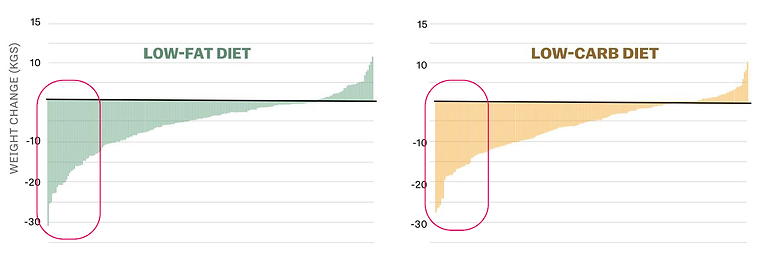
The two groups stuck to their assigned diets — a sign of well-executed work. There were no significant differences in weight loss between the two groups. Neither genetics nor insulin levels could predict weight loss. The differences in weight loss between individuals on the same diet were much larger than the variations between diets — suggesting that differences in adherence were more important than differences in diet.
The third NuSI study: a finding that did not survive reanalysis.
The third study5 compared the effects of low-fat and low-carb diets on metabolism through 20 weeks of weight maintenance following weight loss. In support of the carbohydrate-insulin hypothesis, the authors reported that a very low-carbohydrate diet led to a higher metabolic rate than a low-fat diet.
However, a reanalysis of the raw data suggests the effect may be an artifact. As Kevin Hall described it: analyzing the data according to the original pre-registered statistical plan resulted in no statistically significant effects of diet composition on energy expenditure. This alternative analysis is also consistent with a meta-analysis of 32 controlled studies that found energy expenditure favoured low-fat diets.
Taken together, it has been a tough few years for the science of low-carb dieting and the carbohydrate-insulin hypothesis.

What about intermittent fasting?
Ethan Weiss, a cardiologist at UCSF, was successful losing weight using intermittent fasting — but he was uncomfortable recommending it to his patients because of a lack of research with human subjects. He decided to conduct the first-ever human randomized controlled trial comparing intermittent fasting with continuous eating. The researchers chose a 12 PM–8 PM eating window. The primary endpoint was weight loss at 12 weeks.
The TREAT trial: a negative result for intermittent fasting.
The TREAT trial6 was published in 2020. As Ethan Weiss summarized: "This was a negative study. Intermittent fasting did not lead to a statistically significant difference in weight loss at 12 weeks."
There were also no differences between groups in insulin, glucose, lipids, sleep, activity, metabolism, or fat mass. Of note — and a potential warning of harm — the intermittent fasting group was found to lose more lean mass (muscle) than the continuous eating group.
Adherence is the key, not diet.
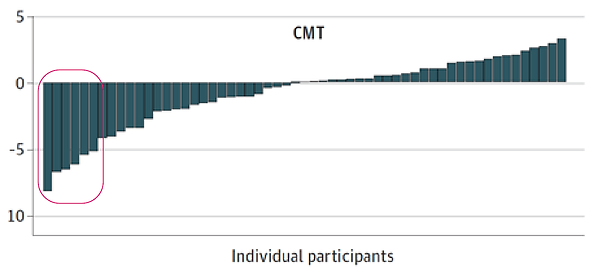
Across all of these trials, look at the individuals in each waterfall plot who lost the most weight. They are the participants who best maintained adherence to the behavioural changes — primarily, to eating less. The only consistent finding among trials that compare diets is that adherence — the degree to which participants maintained effort and continued in the program — was strongly associated with weight loss and improved health.
Can you find help with adherence? It is the fundamental role of a weight management behavioural program to support and improve adherence. Behavioural programs lead to greater success because they support adherence. The eight modules in this material comprise a comprehensive behavioural program.

Eating healthily
Eating healthily promotes the health of body and mind. There is minimal controversy as to what constitutes eating healthily: minimally-processed whole grains, fruits, vegetables, lean proteins, lean dairy, good fats, and minimal alcohol. At the same time, most of us value food and drink, fun and friends, socialization, celebration — and the unique role food and drink play in all of these experiences.
Would you consider finding your own "best" diet — the healthiest eating that is realistic, enjoyable, and sustainable? The behaviours and effort level adopted to lose weight will be the same behaviours and effort level needed to maintain weight loss. Consider eating in a pattern and at an effort level that is both enjoyable and sustainable.
In a parallel nutritional program, you will learn about the calorie density of foods and how to estimate portion sizes, so that you can make the best assessment of your calorie intake. You will be invited to consider tracking your intake — while being made aware that self-monitoring of food and drink intake is not for everyone.
Exercise
Next to quitting smoking, physical activity is the most valuable behaviour available to improve longevity, quality of life, and reduce the risk of chronic disease. You will be encouraged in this program to be active, to identify obstacles to physical activity, and to develop skills and strategies to overcome those obstacles.
Surprisingly, studies show that exercise alone will not promote significant weight loss in most people. An important systematic review and meta-analysis7 of randomized controlled trials found that moderate-intensity exercise programs of 6 to 12 months' duration were associated with only modest improvements in weight (~4 pounds), waist circumference (~2 cm), and cardiovascular risk in populations with overweight and obesity.
Why exercise is limited as a weight loss tool
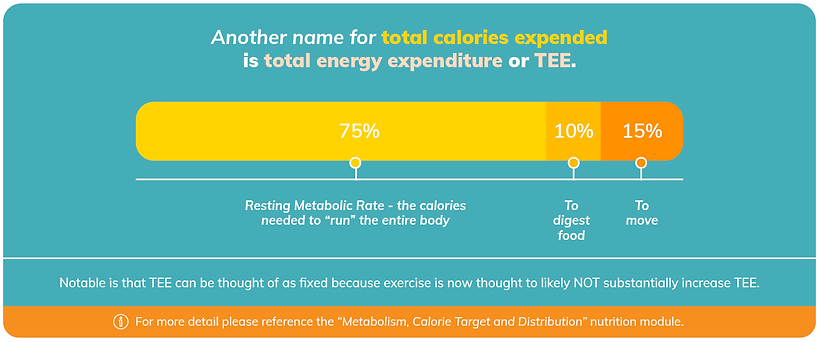
Exercise, despite its significant health and quality of life benefits, may have significant limitations in its ability to establish a calorie deficit. In a landmark clinical trial, Herman Pontzer8 and colleagues showed that even low levels of physical activity increase the number of calories we burn — but at higher levels of activity, there is no expected rise in energy expenditure. The body adapts to maintain total energy expenditure within a narrow range. This is called the constrained model of energy expenditure.
What this model suggests is that if you were to burn 400 calories today on a treadmill, your body would, over time, burn 400 calories less than what it was going to anyway — to make up for the extra calories you burned. If this seems unfair, it may seem less unfair if you consider that this mechanism would have been adaptive in an environment where work was required to find food and calories could be scarce.
Why exercise is still essential
This information is critical to understanding the place of exercise in weight management — but it must be read alongside the rest of what exercise does for you.
You learned in the Modulators module that stress, fatigue, depressed mood, and anxiety can all challenge weight loss efforts by increasing your appetite and decreasing your ability to self-regulate against wanting. Exercise can be very beneficial because it clearly and positively impacts stress, fatigue, and mood. In fascinating trials9, exercise has been shown to potentially directly reduce wanting signals in the brain, dampening the motivation system.
Like best diet, you will be asked to establish your best activity level — the highest level of activity that is enjoyable, reasonable, and sustainable.
Find your best diet. Find your best activity level. Define best as: the healthiest you can maintain that is still enjoyable.
- Hall KD, Guo J. Obesity Energetics: Body Weight Regulation and the Effects of Diet Composition. Gastroenterology. 2017. View source ↩
- Ravussin E et al. Twenty-four-hour energy expenditure and resting metabolic rate in obese, moderately obese, and control subjects. American Journal of Clinical Nutrition. 1982. View source ↩
- Hall KD et al. Energy expenditure and body composition changes after an isocaloric ketogenic diet in overweight and obese men. American Journal of Clinical Nutrition. 2016. View source ↩
- Gardner CD et al. Effect of Low-Fat vs Low-Carbohydrate Diet on 12-Month Weight Loss in Overweight Adults and the Association With Genotype Pattern or Insulin Secretion: The DIETFITS Randomized Clinical Trial. JAMA. 2018. View source ↩
- Ebbeling CB et al. Effects of a low carbohydrate diet on energy expenditure during weight loss maintenance: randomized trial. BMJ. 2018. View source ↩
- Lowe DA, Wu N, Rohdin-Bibby L, Moore AH, Kelly N, Liu YE, Philip E, Vittinghoff E, Heymsfield SB, Olgin JE, Shepherd JA, Weiss EJ. Effects of Time-Restricted Eating on Weight Loss and Other Metabolic Parameters in Women and Men With Overweight and Obesity: The TREAT Randomized Clinical Trial. JAMA Internal Medicine. 2020. View source ↩
- Shaw KA, Gennat HC, O'Rourke P, Del Mar C. Exercise for overweight or obesity. Cochrane Database of Systematic Reviews. 2006. View source ↩
- Pontzer H et al. Constrained Total Energy Expenditure and Metabolic Adaptation to Physical Activity in Adult Humans. Current Biology. 2016. View source ↩
- Cornier MA et al. The effects of exercise on the neuronal response to food cues. Physiology & Behavior. 2012. View source ↩